


The Invisible Line: THC Limits by State
Cannabis laws in the United States have changed dramatically over the past decade. What was once broadly prohibited is now legal in many places for medical or recreational use. But for drivers, that shift has created a legal gray area that isn’t always obvious.
Alcohol laws are straightforward: A nationwide 0.08% blood alcohol concentration limit defines impairment. THC laws are different. Each state sets its own marijuana DUI rules, often with little connection to whether cannabis use itself is legal.
To make sense of this complexity, the team at Joslyn Law Firm created an infographic breaking down THC limits and driving laws across all 50 states. It highlights the “invisible line” drivers can cross without realizing it — where legal behavior in one state can quickly become a criminal offense in another.
Click to view the full-size infographic
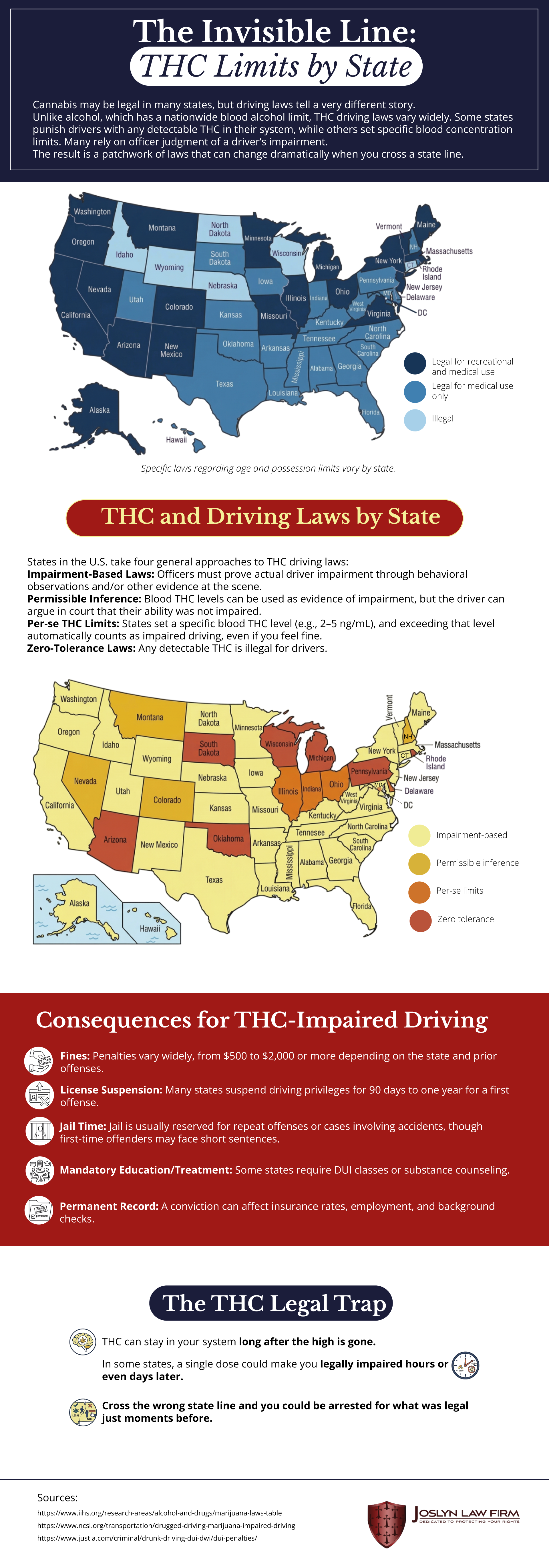
Understanding THC and Driving Laws in the United States
Across the country, cannabis legality falls into three broad categories:
- Legal for Recreational and Medical Use: Many states, including California, New York, and Colorado, allow adult use of cannabis.
- Medical Use Only: A majority of states permit cannabis strictly for medical purposes with qualifying conditions.
- Fully Illegal: A shrinking number of states still prohibit cannabis entirely.
But marijuana legalization does not extend to the driver’s seat. Even in the growing number of states where weed is legal for both medical and recreational use, driving while high remains illegal — and how that’s defined can vary dramatically.
On top of that, THC laws outlining age limits, legal possession amounts, and where cannabis can be used differ from state to state, adding yet another layer of complexity for both residents and travelers.
Federal Law Still Complicates Marijuana DUI Cases
Although cannabis laws have shifted dramatically across the United States, federal marijuana classification and enforcement standards remain legally complex and continue evolving.
In 2026, the DOJ and DEA issued a limited federal rescheduling order moving certain FDA-approved marijuana products and qualifying state-licensed medical marijuana products into Schedule III, while most recreational marijuana remained federally classified as Schedule I. Marijuana-related DUI and OVI enforcement nevertheless continues to be governed primarily by state impaired-driving laws and varying THC enforcement standards.
For many drivers, the issue is not whether cannabis was legally purchased or consumed, but how a particular jurisdiction defines impairment once a person gets behind the wheel. A driver who lawfully uses marijuana in one state may still face criminal exposure in another based on that state’s THC driving standards, chemical-testing rules, or zero-tolerance enforcement policies.
In marijuana-related traffic stops, law enforcement officers often focus less on the legality of possession itself and more on whether there is evidence suggesting impaired operation of a vehicle. Depending on the jurisdiction, investigators may rely on multiple forms of evidence during a stop or subsequent DUI investigation.
Drivers should also understand:
- Legal cannabis use does not prevent DUI or OVI charges
- States apply dramatically different standards when evaluating THC impairment
- Some jurisdictions permit prosecutors to pursue impaired-driving allegations based largely on chemical-test evidence and measurable THC concentrations
- Marijuana-related investigations frequently involve toxicology evidence, officer observations, field sobriety testing, and driving behavior
- Crossing state lines can instantly change the legal standards governing marijuana-related driving offenses
Because marijuana laws continue evolving at both the state and federal level, drivers can unknowingly expose themselves to criminal liability even when their cannabis use was otherwise lawful.
The Four Types of THC Driving Laws
States generally take one of four approaches to marijuana and DUI:
- Impairment-Based Laws
These states require law enforcement to prove that a driver was actually impaired. Officers rely on observed behavior, field sobriety tests, and other on-scene evidence.
- This is the most common approach to THC and driving in the U.S.
- These THC laws focus on real-world impairment rather than chemical thresholds
- Permissible Inference Laws
Here, THC blood levels can be used as evidence, but they are not definitive proof of impairment.
- Drivers can argue they were not impaired despite elevated THC levels.
- Courts weigh the driver’s THC concentration alongside other evidence.
- Per-se THC Limits
These states set a legal limit for THC while driving, often a blood concentration of between 2 and 5 ng/mL.
- Exceeding the limit automatically qualifies as impaired driving.
- This is similar in concept to the 0.08% BAC rule for alcohol-impaired driving.
- Zero-Tolerance Laws
This is the strictest approach to marijuana and DUI: Any detectable amount of THC can result in a DUI charge.
- Even trace amounts in your system, long after impairment has faded, may trigger penalties.
- These laws create risk for occasional or infrequent users.
How Marijuana DUI Investigations Often Work
Marijuana-related DUI and OVI investigations are often considerably more complex than alcohol-related traffic stops because there is no universally accepted scientific consensus equating a specific THC concentration with actual driving impairment behind the wheel.
Unlike alcohol, which is metabolized at a relatively predictable rate, THC affects drivers differently depending on dosage, frequency of use, body chemistry, and the timing of consumption.
As a result, law enforcement officers and prosecutors frequently rely on a combination of observational evidence, toxicology results, and investigative findings when evaluating whether a driver may have been impaired at the time of a traffic stop.
During a marijuana-related DUI investigation, officers may consider:
- Driving behavior observed prior to the stop, including speeding, drifting, delayed reactions, or erratic operation
- Physical indicators such as bloodshot eyes, slowed coordination, impaired reaction time, or the odor of marijuana
- Statements made by the driver regarding recent cannabis consumption
- Performance during field sobriety testing and other roadside evaluations
- Toxicology evidence obtained through blood or chemical testing following the stop
Unlike many alcohol-related DUI cases, marijuana impairment allegations often involve fact-specific evidentiary disputes. Prosecutors may attempt to combine chemical-test evidence with officer testimony, roadside observations, and other circumstantial evidence to establish impairment.
Because THC remains detectable in the body long after intoxicating effects may have diminished, marijuana-related DUI and OVI cases frequently involve scientific, forensic, and evidentiary issues that differ substantially from traditional alcohol-impaired driving prosecutions.
How States Differ
One of the most striking takeaways is how little consistency exists between states.
- Some states with legal recreational cannabis still enforce zero-tolerance laws.
- Others with medical-only programs rely on impairment-based enforcement.
- A smaller group uses per-se limits to create measurable thresholds.
There’s no clear regional pattern here, and there’s no reliable way to guess THC laws based on a state’s stance on marijuana legalization.
That means crossing a state line can instantly change your legal exposure, even if your behavior doesn’t change at all.
Why Per-Se THC Laws Remain Controversial
Per-se THC driving laws were designed to create a measurable legal threshold for marijuana impairment, similar to blood alcohol concentration limits used in alcohol-related DUI cases. In practice, however, marijuana-related impaired-driving enforcement remains far more complicated because THC does not behave in the body the same way alcohol does.
One of the central legal controversies surrounding per-se THC laws is that measurable THC concentrations do not always correspond to active driving impairment. Depending on the individual, THC may remain present in blood or bodily fluids long after the psychoactive effects associated with marijuana use have subsided.
That distinction has become a major issue in marijuana-related DUI and OVI prosecutions, particularly in states that allow prosecutors to pursue criminal charges based heavily on chemical-test evidence. In some situations, drivers may face allegations of impaired driving despite exhibiting limited outward signs of intoxication during a traffic stop.
Several factors continue to complicate per-se THC enforcement:
- States apply different THC concentration thresholds when evaluating suspected marijuana impairment
- Chemical-test results may not reliably establish when cannabis was consumed or whether active impairment still existed during vehicle operation
- Frequent cannabis users may maintain detectable THC concentrations despite showing limited signs of impairment
- Toxicology evidence often becomes the subject of scientific and evidentiary disputes during DUI litigation
- Marijuana-related DUI investigations frequently involve forensic issues that are less common in alcohol-related impaired-driving cases
As marijuana legalization continues expanding nationwide, the debate surrounding per-se THC laws remains one of the most contested areas of impaired-driving enforcement and criminal-defense litigation.
The Consequences of THC-Impaired Driving
The penalties for THC-related driving offenses are significant and often mirror or match those for alcohol-related DUIs:
- Fines: Typically range from $500 to $2,000 or more, depending on the state and prior offenses
- License Suspension: First-time offenders often face a suspension lasting from 90 days up to one year.
- Jail Time: More common for repeat offenses or accidents, but possible even for first-time offenders in some cases
- Mandatory Education or Treatment: DUI programs or substance counseling may be required.
- Permanent Record: A conviction can affect employment, background checks, and insurance rates.
Marijuana DUI Charges Can Carry Long-Term Consequences
For many drivers, the consequences of a marijuana-related DUI or OVI charge extend far beyond the immediate penalties imposed in court. Even a first-time offense can create long-term financial, professional, and personal complications that continue well after the criminal case itself has concluded.
Because many states treat marijuana-related impaired-driving allegations similarly to alcohol-related DUI offenses, a conviction may carry consequences affecting employment opportunities, professional licensing, driving privileges, and future criminal exposure. In some cases, administrative penalties tied to a driver’s license can begin before the criminal case is fully resolved.
Drivers facing marijuana-related DUI allegations may also encounter:
- Increased insurance premiums or policy cancellations following a conviction
- Commercial driver’s license (CDL) restrictions or disqualification
- Employment-related disciplinary action or complications during future background checks
- Professional licensing concerns involving healthcare workers, attorneys, teachers, nurses, and other licensed professionals
- Probation or parole violations connected to controlled-substance allegations
- Enhanced criminal penalties for repeat offenses, accidents involving injury, or aggravating circumstances
In many jurisdictions, marijuana-related DUI and OVI charges are treated as serious criminal offenses regardless of whether cannabis use itself was otherwise lawful. As a result, even a single THC-related allegation can create lasting legal and financial consequences for drivers.
The Science Problem: Why THC Is Harder to Regulate Than Alcohol
Part of the inconsistency in marijuana DUI laws comes down to science. THC behaves very differently from alcohol in the human body, making it much harder to define a clear legal limit for THC while driving.
- THC can remain detectable in your body long after the high wears off.
- Frequent users may have baseline THC levels even when they’re not high.
- There’s no universally accepted link between THC concentration and actual impairment of a person’s ability to drive.
This uncertainty helps explain why states have adopted such different legal frameworks — and why enforcement can feel uneven.
The Forensic Challenges Behind THC DUI Cases
One of the most difficult issues in marijuana-related DUI and OVI enforcement is the distinction between THC detectability and actual impairment. Unlike alcohol, which generally leaves the body at a relatively predictable rate, THC can remain detectable long after the psychoactive effects associated with marijuana use have diminished.
That distinction creates significant forensic and evidentiary challenges during impaired-driving investigations, particularly in jurisdictions that rely heavily on blood-test evidence when evaluating suspected marijuana impairment.
In many marijuana-related DUI cases, toxicology evidence may raise complicated questions regarding when cannabis was consumed, how long impairment may have lasted, and whether detectable THC concentrations actually reflect impaired driving at the time of the stop.
Forensic complications may include:
- Active THC and inactive THC metabolites remaining in the body for different lengths of time
- Delays between a traffic stop and chemical testing affecting toxicology interpretation
- Blood-test results that do not clearly establish whether active impairment existed during vehicle operation
- Frequent cannabis users maintaining detectable THC concentrations despite exhibiting limited signs of intoxication
- Competing expert opinions regarding impairment analysis, toxicology evidence, and chemical-test interpretation
These scientific uncertainties are one reason marijuana-related DUI prosecutions often become substantially more complex than traditional alcohol-related impaired-driving cases. In many situations, prosecutors, toxicologists, and defense attorneys may disagree sharply regarding what chemical-test evidence actually proves about a driver’s level of impairment.
As marijuana legalization continues evolving nationwide, courts and lawmakers continue grappling with how THC impairment should be evaluated during criminal investigations and DUI prosecutions.
The THC Legal Trap
This is where the “invisible line” becomes most dangerous.
- THC can stay in your system long after the high is gone.
- In some states, even a single use could leave you legally impaired hours or even days later.
- Crossing from states where weed is legal and driving laws are more relaxed into a stricter state can expose you to arrest for behavior that was legal just moments before.
For example, a driver leaving a state with impairment-based marijuana DUI laws could unknowingly enter a zero-tolerance state, where residual THC alone is enough for a DUI charge.
Why Legal Cannabis Use Can Still Lead to DUI Charges
Many drivers mistakenly assume that legally purchasing or consuming cannabis automatically protects them from marijuana-related DUI or OVI allegations. In reality, lawful cannabis use and impaired-driving enforcement are treated as entirely separate legal issues in most states.
Even drivers who legally use marijuana for recreational or medical purposes may still face criminal investigation if law enforcement believes THC impairment affected their ability to safely operate a vehicle. Depending on the jurisdiction, prosecutors may pursue charges based on toxicology evidence, officer observations, field sobriety testing, driving behavior, or a combination of multiple forms of evidence gathered during the stop.
Several factors continue creating legal risk for drivers across the United States:
- THC may remain detectable long after the intoxicating effects associated with marijuana use have faded
- Some states continue enforcing zero-tolerance or per-se THC driving laws regardless of whether cannabis use itself was lawful
- Marijuana-related traffic stops often rely heavily on officer observations and roadside impairment evaluations
- Drivers crossing state lines may unknowingly encounter dramatically different THC enforcement standards
- Prosecutors may still pursue DUI or OVI allegations even when toxicology evidence does not conclusively establish active impairment
Because marijuana laws, THC thresholds, and impaired-driving standards vary so widely from state to state, drivers should not assume that legal cannabis use automatically eliminates the possibility of criminal investigation or prosecution.
What Drivers Need to Know
For drivers, the takeaway is simple: Legality does not equal safety behind the wheel.
If you use cannabis, whether medically or recreationally, it’s important to consider:
- How recently you consumed it
- Whether you are crossing state lines
- The type of THC laws enforced in your destination
When in doubt, the safest option is also the simplest: Don’t drive after using cannabis.
If you have questions about how these laws apply to your situation, it may help to explore your legal options. A criminal defense attorney in your area can give you guidance if you’re facing an OVI charge or representation for a drug-related offense. Understanding your rights early can make a meaningful difference in the outcome of your case.
Breaking Down the Data
States Where Weed Is Legal
| State | Legal for recreational use? | Legal for medical use? |
| Alabama | No | Yes |
| Alaska | Yes | Yes |
| Arizona | Yes | Yes |
| Arkansas | No | Yes |
| California | Yes | Yes |
| Colorado | Yes | Yes |
| Connecticut | Yes | Yes |
| Delaware | Yes | Yes |
| District of Columbia | Yes | Yes |
| Florida | No | Yes |
| Georgia | No | Yes |
| Hawaii | No | Yes |
| Idaho | No | No |
| Illinois | Yes | Yes |
| Indiana | No | Yes |
| Iowa | No | Yes |
| Kansas | No | Yes |
| Kentucky | No | Yes |
| Louisiana | No | Yes |
| Maine | Yes | Yes |
| Maryland | Yes | Yes |
| Massachusetts | Yes | Yes |
| Michigan | Yes | Yes |
| Minnesota | Yes | Yes |
| Mississippi | No | Yes |
| Missouri | Yes | Yes |
| Montana | Yes | Yes |
| Nebraska | No | No |
| Nevada | Yes | Yes |
| New Hampshire | No | Yes |
| New Jersey | Yes | Yes |
| New Mexico | Yes | Yes |
| New York | Yes | Yes |
| North Carolina | No | Yes |
| Ohio | Yes | Yes |
| Oklahoma | No | Yes |
| Oregon | Yes | Yes |
| Pennsylvania | No | Yes |
| Rhode Island | Yes | Yes |
| South Carolina | No | Yes |
| South Dakota | No | Yes |
| Tennessee | No | Yes |
| Texas | No | Yes |
| Utah | No | Yes |
| Vermont | Yes | Yes |
| Virginia | Yes | Yes |
| Washington | Yes | Yes |
| West Virginia | No | Yes |
| Wisconsin | No | Yes |
| Wyoming | No | Yes |
THC and Driving Laws by State
| State | Type of THC laws |
| Alabama | Impairment-based |
| Alaska | Impairment-based |
| Arizona | Zero tolerance |
| Arkansas | Impairment-based |
| California | Impairment-based |
| Colorado | Permissible inference |
| Connecticut | Impairment-based |
| Delaware | Zero tolerance |
| District of Columbia | Impairment-based |
| Florida | Impairment-based |
| Georgia | Zero tolerance |
| Hawaii | Impairment-based |
| Idaho | Impairment-based |
| Illinois | Per-se limits |
| Indiana | Zero tolerance |
| Iowa | Zero tolerance |
| Kansas | Impairment-based |
| Kentucky | Impairment-based |
| Louisiana | Impairment-based |
| Maine | Impairment-based |
| Maryland | Impairment-based |
| Massachusetts | Impairment-based |
| Michigan | Zero tolerance |
| Minnesota | Impairment-based |
| Mississippi | Impairment-based |
| Missouri | Impairment-based |
| Montana | Per-se limits |
| Nebraska | Impairment-based |
| Nevada | Per-se limits |
| New Hampshire | Impairment-based |
| New Jersey | Impairment-based |
| New Mexico | Impairment-based |
| New York | Impairment-based |
| North Carolina | Impairment-based |
| Ohio | Per-se limits |
| Oklahoma | Zero tolerance |
| Oregon | Impairment-based |
| Pennsylvania | Zero tolerance |
| Rhode Island | Zero tolerance |
| South Carolina | Impairment-based |
| South Dakota | Zero tolerance |
| Tennessee | Impairment-based |
| Texas | Impairment-based |
| Utah | Zero tolerance |
| Vermont | Impairment-based |
| Virginia | Impairment-based |
| Washington | Per-se limits |
| West Virginia | Impairment-based |
| Wisconsin | Zero tolerance |
| Wyoming | Impairment-based |
Sources:
https://www.iihs.org/research-areas/alcohol-and-drugs/marijuana-laws-table
https://www.ncsl.org/transportation/drugged-driving-marijuana-impaired-driving
https://www.justia.com/criminal/drunk-driving-dui-dwi/dui-penalties/
https://www.federalregister.gov/documents/2026/04/28/2026-08176/schedules-of-controlled-substances-rescheduling-of-food-and-drug-administration-approved-products
https://www.nhtsa.gov/sites/nhtsa.gov/files/documents/812440-marijuana-impaired-driving-report-to-congress.pdf
https://nij.ojp.gov/topics/articles/field-sobriety-tests-and-thc-levels-unreliable-indicators-marijuana-intoxication
This page was last updated by Brian Joslyn